
The Fighting Quaker
- dtmillerlexky
- Aug 23, 2023
- 6 min read
Updated: Dec 26, 2023
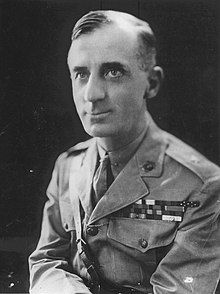
It's late 1934. Major General Smedley Butler—nicknamed "The Fighting Hell-Devil" and "Old Gimlet Eye"—was the most decorated Marine of all time and has just retired. Now he's sitting in a closed committee hearing of the U.S. House of Representatives. He's no longer in uniform, so no one sees his two Medals of Honor or countless battle ribbons, but everyone knows he is.
He's there to be questioned about claims he's made on his recent speaking tour, where he said he was "trying to educate the soldiers out of the sucker class." In speech after speech he railed against war profiteers, claiming that "war is a racket" and the U.S. had no business getting into so many foreign entanglements. Butler had fought in Honduras, Mexico, Venezuela, and Haiti, and in his view gigantic corporate interests had co-opted the American military to protect their profits, not the public interest. (For a video of Butler speaking click here)
Butler made the speech dozens of times, often before veteran groups such as the Veterans of Foreign Wars but rarely before the rival American Legion, saying that it was controlled by big business.
What really caught the House committee's attention weren't his broadsides against war in general but his claim that he'd been approached by a cabal of corporate leaders plotting to overthrow the U.S. government and establish a pro-business Fascist regime. They allegedly wanted Butler to help lead an "army" of disgruntled World War I veterans to do it.
The special House committee, formed to investigate "Nazi Propaganda and Certain Other Propaganda Activities," was led by representatives John W. McCormick of Massachusetts and Samuel Dickstein of New York. McCormick was a strong supporter of President Roosevelt, while Dickstein had been a major player in the corrupt Tammany Hall machine of the early 1900s.
Butler testified that he'd been asked to lead such a "veteran army" to oust President Roosevelt, and he named names of those he understood to be behind the plot. In Butler's telling, the cabal promised him vast powers over the federal government, with Roosevelt remaining president in name only.
Many of those he named were either not called as witnesses by the committee or were eventually scrubbed from the committee's final report. They included Wall Street financiers such as bankers Grayson Murphy and J.P. Morgan, the DuPonts, Remington Arms, and a dozen others supposedly in on the plan. Butler called Morgan one of the main plotters and claimed the group had pooled $3 million to fund the coup.
There was little need to speculate on their motive—business interests hated Roosevelt and his economic policies. And, considering what was then happening in Germany and Italy, the idea of America becoming a Fascist state wasn't far-fetched.
The vehicle for the coup would be the World War I veterans who hadn't gotten the pensions or bonuses they were promised; in the depths of the Depression, the government didn't have the money. Hundreds of thousands had already marched on Washington, and they respected Butler. He visited them at their tent camps and encouraged them to keep standing up for what they were due.
Butler would have been the perfect leader for a coup, universally admired by both servicemen and the public, with a chest full of medals and the gravitas to lead a squad, a battalion, or ad-hoc army of vets.
Instead, he went public, detailing the plot in his speeches.
At first, The New York Times called Butler's claims a hoax dreamed up by a crackpot. But the House committee took notice and called him to testify. It refused to subpoena some of the business leaders who'd been implicated—"The committee will not take cognizance of names brought into the testimony which constitute mere hearsay." All of those who did testify said under oath said that they were aware of no such plot.
But the evidence began to mount. When the leader of the VFW testified that he'd been approached about organizing a Fascist-friendly veterans' group to descend on Washington, the Times and other papers began to change their mocking tone to a more sober one. Eventually, the Times reversed course entirely, saying it was "convinced that General Butler's story of a Fascist march on Washington was alarmingly true."
The Committee eventually issued a report, hedging its conclusions in line with its mandate to focus on foreign influence: "In the last few weeks of the committee's official life it received evidence showing that certain persons had made an attempt to establish a Fascist organization in this country. No evidence was presented and this committee had none to show a connection between this effort and any Fascist activity of any European country."
But it concluded that there was a plot to overthrow the government--it just hadn't been carried out. "There is no question that these attempts were discussed, were planned, and might have been placed in execution when and if the financial backers deemed it expedient," according to the committee report.
The New York Times was forced to acknowledge that there was both smoke and fire in Butler's story, concluding that "definite proof had been found that the much-publicized Fascist march on Washington, which was to have been led by Major Gen. Smedley D. Butler, retired, according to testimony at a hearing, was actually contemplated."
It's still debated how far the plot actually got, and the march on Washington never happened.
Despite the committee refusing to call the biggest business leaders in for testimony or name them in its report, Butler's experience before the committee encouraged him to double down on his claim that business interests drove much of American foreign policy.
For the rest of his life he warned anyone who'd listen that big-money capitalists would drive America into Fascism if they could. He produced a short book, also called "War is a Racket," based on his speeches, arguing that "[o]nly a small 'inside' group knows what [war] is about. It is conducted for the benefit of the very few, at the expense of the very many. Out of war a few people make huge fortunes."
Butler remained popular with veterans even as he spoke out against war. In his view, soldiers are often just cannon fodder. "I spent 33 years and four months in active military service and during that period I spent most of my time as a high-class muscle man for Big Business, for Wall Street and the bankers," he said. "In short, I was a racketeer; a gangster for capitalism."
Butler listed all the Marine Corps actions he'd been involved in, calling out the oil, sugar, fruit and other corporate interests pushing for each. "Looking back on it, I might have given Al Capone a few hints. The best he could do was to operate his racket in three districts. I operated on three continents."
He often spoke to pacifist groups, earning him a new nickname, "The Fighting Quaker." He argued that the military should be limited to national self-defense, with the Navy operating no more than 200 miles off the coast and the Army restricted to America's territorial limits.
Butler continued to give such speeches until his death at age 58 in 1940, just a year before the Japanese attack on Pearl Harbor pulled America into the most expansive war in history.
Butler's allegations about a Fascist cabal came to be known as "The Business Plot" and the hearing and report left many loose threads that are still being explored.
For example, according to later research by the BBC, Prescott Bush, father of one U.S. president and grandfather of another, was reportedly a "key liaison" between the American business plotters and the rising Nazi regime in Germany.
Some historians have disputed this claim, with one, Jonathan Katz, arguing that "Prescott Bush was too involved with actual Nazis to be involved with something as homegrown as the business plot."
Many years later, when Soviet-era files were made public, the staunchly anti-Fascist Congressman Dickstein was revealed to have been a paid secret agent for Russia during the time of the Business Plot hearings.
In a few years that special House committee would be made permanent and rechristened as the notorious House Un-American Activities Committee.
According to an analysis by The Guardian, the Iraq and Afghanistan wars cost the United States as much as $5 trillion dollars in total, and stocks of the Big Five defense contractors outperformed the stock market by 60% during those conflicts.
For more on the Business Plot, see "Gangsters of Capitalism": Jonathan Katz on the Parallels Between Jan. 6 and 1934 Anti-FDR Coup Plot. Democracy Now!. Retrieved 26 January 2022.
Copyright 2023 David Thurman Miller.


Butler was a big peace hero. Too bad he was unable to influence the US government to stop starting wars so businesses could make huge fortunes!