
The Statesman
- dtmillerlexky
- Jul 19, 2023
- 2 min read
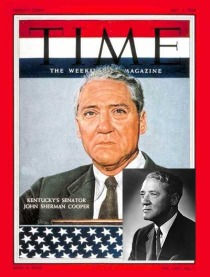
John Sherman Cooper was born in Somerset, Kentucky in 1901. A lifelong Republican, he studied at Centre College and Yale and received his law degree from Harvard. He served as a local judge and member of the state House of Representatives before beginning his career in the US Senate in 1946, first to fill the unexpired term of the resigning "Happy" Chandler and then elected to a full term on his own. He lost his first reelection bid but both parties recognized that he was far too valuable to sit on the sidelines. President Truman appointed him as US delegate to the United Nations and President Eisenhower as ambassador to India, and he was highly effective in both roles.
At the urging of President Eisenhower, Cooper again ran for the US Senate in 1957 and, once settled in, won reelection by wide margins through his retirement in 1972. He served during a particularly tumultuous era in America, and was known for speaking and voting his conscience rather than his party, but he seemed to make few enemies. He stood up to the demagogue Joe McCarthy on the Senate floor, worked against the filibuster then blocking civil rights legislation, opposed the Vietnam war, pushed for nuclear arms limitations, and supported workers' collective bargaining rights. While still a senator he was tapped by President Kennedy to conduct secret diplomacy with the Soviets and served on the Warren Commission, publicly criticizing its conclusion that Lee Harvey Oswald acted alone.
Called the "global Kentuckian," Cooper became well-known to the general public and was highly regarded by his fellow senators. He appeared on the cover of Time magazine and was repeatedly named in polls as one of the country's most effective and admired public servants. One colleague said "fellow senators lowered their voices and listened instead of just attacking" when Cooper spoke. Another that he "always brought light to the problem rather than heat."
Cooper repeatedly warned that the American experiment in democracy is fragile and unique, and in constant need of recommitment by its leaders and its citizens.
After Cooper left the Senate, President Ford appointed him ambassador to East Germany, and when Cooper died in 1991 President Reagan eulogized him as "one of the most beloved and compassionate American statesmen of this or any other century." Cooper is buried in Arlington National Cemetery.
Because Cooper so often voted against his party it might be assumed that his legacy would be problematic for the party as it exists today. But Senator Mitch McConnell, who rose from being Cooper's intern to become inarguably one of the most consequential leaders in Senate history, gave a lengthy speech about Cooper, calling him "my personal hero," adding that "in all my years of public life, there’s been no one from whom I’ve learned more… He was everything you'd want in a public servant.”
I reached out to Senator McConnell's office to ask for a full copy of his speech, but his official telephone number is out of service. Emails brought no response.
Photos courtesy Time Magazine/Official US Senate photo


Comments